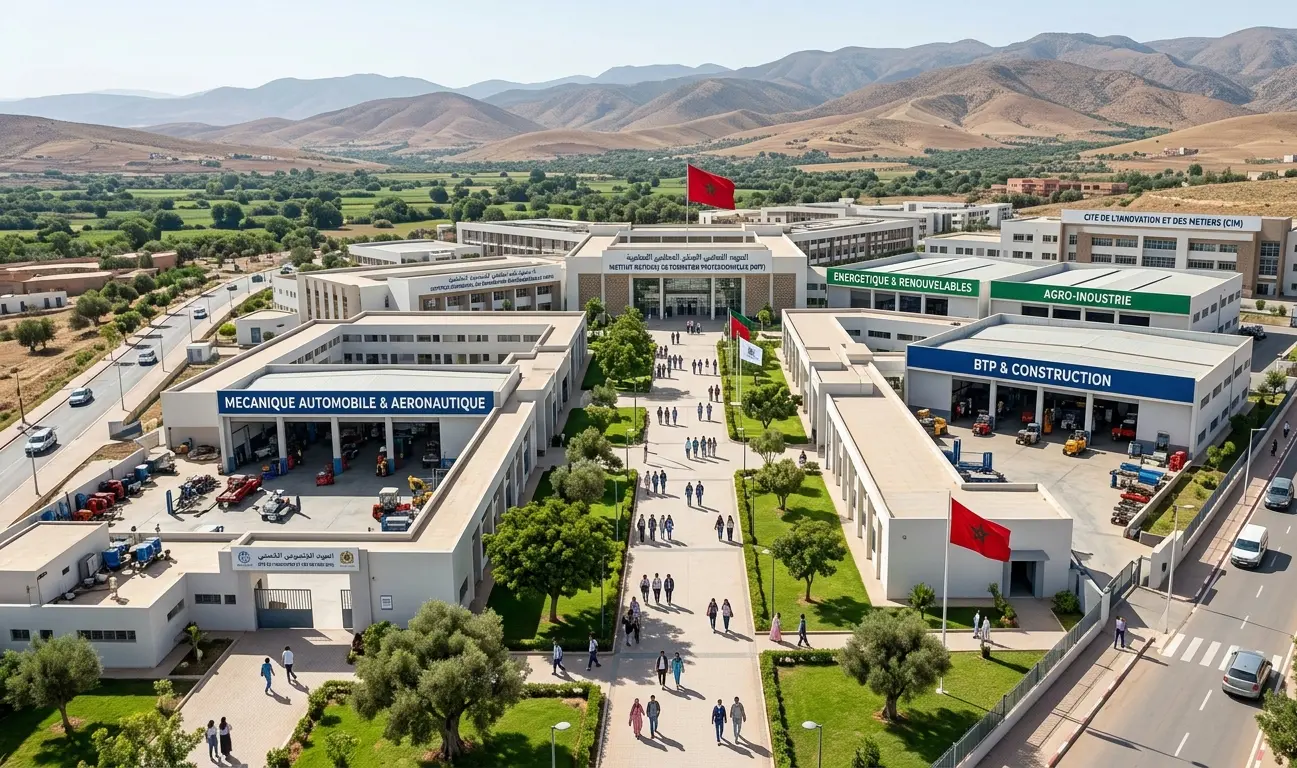
Cité des Métiers et des Compétences — Morocco
BOT / PPP Concession · OFPPT Feuille de Route 2026 Morocco — 12 Regional CMC Campuses · Active Pipeline
CMC · Vocational Training · BOT/PPP Concession

Vocational Training Cities
746,500 Trainees. The State Builds the Demand. You Operate the Asset.

Morocco's Royal mandate created 12 next-generation vocational campuses — CMCs — across every region of the Kingdom.
The government builds them. The government fills them. Private operators are now invited to manage, co-develop, and scale them.
The concession window is open. The demand is sovereign-guaranteed. The market is already inside.

Not all applicants are reviewed. Access is not automatic.
Verified active pipeline · OFPPT PPP roadmap · PLF 2026 confirmed · 12 CMC campuses operational or under construction
Deal Intelligence — Restricted
Asset CMC Network — BOT / Management Concession
Current Status Active — OFPPT PPP Filialisation Wave
Confirmed Fact CMC governance structured as SA companies · PPP explicitly activated by OFPPT board
Last Known Event 746,500 trainees enrolled 2025–26 — capacity gap forces private operator entry
Financial Upside Training fees + corporate contracts + real estate yield + exit multiple 6–9× EBITDA
746,500
Trainees enrolled in Morocco's vocational system in 2025–2026 — up 38% since 2021. 12 CMC campuses mandated by Royal directive. Each is a self-contained ecosystem on 10–20 hectares. OFPPT has publicly committed to PPP filialisation — private management is no longer optional.

The students are already enrolled. The buildings are already built. The concession is what remains.

CMC Campuses
12
One per region · 10 operational · 2 opening 2025–26
Campus Scale
15 Ha
Per campus avg. · 2,000–3,000 training places · on-site residence
Sectors Covered
10+
Trade poles per campus — industry, digital, agriculture, tourism
World Cup 2030
500K
Skilled workers needed · CMCs are the primary delivery pipeline
PPP Structure
SA
CMCs incorporated as Sociétés Anonymes · private equity entry authorised

The Royal Mandate That Created a New Asset Class

In April 2019, Morocco's King presented a national vocational training roadmap before a full ministerial council. The centrepiece was Project 2: the Cités des Métiers et des Compétences — twelve next-generation campus complexes, one per region, combining technical training, digital infrastructure, residential facilities, and industry-linked placement pipelines under a single roof. This was not a pilot programme. It was a sovereign industrial policy decision, backed by full state financing, and carried through with the kind of velocity that Royal directives generate in the Moroccan administration.

By 2025–2026, ten CMCs are fully operational. The final two are opening. Each campus covers 10 to 20 hectares. Each offers 2,000 to 3,000 training places across ten or more sectoral poles — from renewable energy and industrial mechanics to digital infrastructure, agribusiness, and hospitality management. Boarding, cafeterias, sports infrastructure, coworking spaces, Fab Labs, Digital Factories, and incubators are standard across the network. The state built it. The state filled it. The structure is now ready for private operators.

"The CMC is not a vocational school. It is a workforce factory with sovereign demand guarantees, real estate infrastructure, and a captive corporate client base that has no alternative pipeline."

The PPP Structure — What OFPPT Has Actually Opened

The OFPPT board has publicly confirmed that CMCs will be structured as Sociétés Anonymes — joint-stock companies — specifically to enable private equity entry, management concessions, and co-development partnerships. This is not a future aspiration. It is a governance decision already embedded in the CMC legal architecture. The PPP mechanism explicitly contemplated by OFPPT includes three modes: management concession of existing CMC operations, co-investment in new campus expansion (additional halls, residential blocks, specialised labs), and sector-specific training partnerships with international operators who bring curriculum, certification, and placement pipelines.

The structure is already defined. What matters is how you position within it.

The full PPP term sheet, SA governance model, and OFPPT contact protocol are restricted to qualified applicants.

Apply for Qualification for This Concession Not all applicants are reviewed. Access is not automatic.

How You Get Paid — Four Revenue Layers

The CMC revenue model is structurally more diversified than a standard education PPP. Layer one is training fee income: trainees pay MAD 50 in registration fees, but the real revenue is the per-trainee government subsidy and the corporate training contracts with industrial anchors in each region — OCP, Renault, Safran, Stellantis, and dozens of regional SME clusters who have formal partnerships with CMC campuses. Layer two is residential income: the on-campus boarding infrastructure accommodates 16% of the trainee population on average, generating year-round accommodation and catering revenue entirely outside the public budget. Layer three is services income from the commercial infrastructure embedded in each campus — Fab Labs rented to startups, conference centres booked by corporates, Digital Factories contracted by technology companies for short-cycle upskilling programmes. Layer four, available to investors who execute the right structure, is real estate yield: the BEA (Bail Emphytéotique Administratif) over government land combined with campus expansion creates a long-duration asset with compounding income.

The Government's Position in This Investment

OFPPT brings to this concession: the land, the existing buildings, the national brand, the trainee pipeline, the regional employer networks, and the sovereign budget backstop for the training subsidy. The private operator brings: management excellence, international curriculum, corporate placement agreements, and capital for campus expansion. The asymmetry is deliberate. Morocco does not need investors to build the infrastructure — it is already built. It needs operators who can maximise the return on that infrastructure, accelerate placement rates, attract international certifications, and create the kind of outcomes that justify the next wave of expansion.

What You Must Have Before Engaging

The OFPPT evaluation framework for CMC private partners is more demanding than a standard concession tender because the Ministry is not simply outsourcing operations — it is selecting a long-term co-owner of a national brand. Education management or vocational training operational track record is non-negotiable. International certification capability — City & Guilds, German Dual System equivalents, ISO 29990, ILO CINTERFOR methodology — materially differentiates proposals. So does the ability to demonstrate an active employer placement network in Morocco or a comparable MENA market. Corporate training revenue from industrial anchors is not optional upside; it is a core evaluation criterion. Investors who arrive with capital alone and no operational credibility will not pass the first filter.

What Most Investors Miss

Three Things That Will Eliminate Most Applicants

OFPPT has tested private partnership models before. The pattern of failure is consistent. These are not edge cases — they are the structural reasons credible-looking investors get rejected before the first committee review.

⚠ Documented Failure Case — 2022

A European vocational training group with established operations in three MENA countries submitted a CMC partnership proposal to OFPPT's regional directorate in 2022. Their financial structure was sound. Their curriculum credentials were internationally certified. Their proposed management team included former OFPPT directors. The proposal was rejected at the strategic review stage — not for any technical deficiency, but because the group had structured their offer as a service management contract rather than as an equity co-ownership vehicle aligned with the SA model OFPPT had already decided on. They were solving the wrong problem with an answer to a question that was no longer being asked.

The thing they missed: OFPPT does not want a manager. It wants a co-owner with skin in the asset. The distinction between a management contract and a shareholders' agreement is not administrative — it is the entire strategic logic of the CMC PPP. Investors who propose the former reveal that they have not understood what is being offered.

The SA Structure Has a Specific Entry Condition
The Société Anonyme governance model for CMCs is not a blank template. The equity entry conditions, board composition rules, and exit provisions contain one clause that almost every investor misreads on first review. When triggered, it changes the entire capital structure of the deal. It is not disclosed in the public OFPPT documentation.
🔒 SA entry conditions: restricted access
Corporate Contract Revenue Is Not Automatic
Every CMC campus has formal industrial anchor partnerships on paper. The reality of converting those partnerships into paid corporate training revenue requires a relationship activation strategy that is specific to the Moroccan industrial ecosystem. Most investors assume the partnerships transfer with the concession. They do not — at least not on the terms that make the financial model work.
🔒 Corporate activation strategy: restricted
The World Cup 2030 Deadline Creates an Unusual Evaluation Dynamic
Morocco's World Cup 2030 hosting requires approximately 500,000 trained workers in construction, hospitality, logistics, and security by 2029. This timeline is not an incentive — it is a procurement constraint. OFPPT's evaluation committee is scoring CMC partnership proposals against a hard delivery clock that most investors have not mapped to their operational ramp-up timelines.
🔒 Evaluation timeline mechanics: restricted
Entry Paths

Three Ways to Enter the CMC Concession

The OFPPT PPP framework accommodates three distinct investor entry profiles. Each leads to a long-duration asset. Each requires a different operational profile and capital commitment.

Path A
Equity Co-Owner.
SA Shareholder.
Full Platform Control.
You enter the CMC Société Anonyme as a minority shareholder alongside OFPPT. You bring operational expertise, international curriculum, and a placement network. You sit on the board. You influence the training offer, the corporate partnership strategy, and the campus expansion pipeline. This is the path that maximises long-term asset value — and requires the most demanding qualification profile. OFPPT will not dilute ownership to an operator who cannot prove they can improve outcomes.
🔒 Equity entry conditions and pricing: restricted
Path B
Campus Expander.
BEA Land Lease.
New Infrastructure.
You co-invest in campus expansion — new specialised training halls, residential blocks, or sector-specific technology labs — under a Bail Emphytéotique Administratif on government land. You own the infrastructure you build for the duration of the BEA. OFPPT fills the spaces with trainees. You collect lease income and corporate lab-rental revenue. Lower governance complexity than Path A, but requires construction capability and a strong sector partnership to justify the investment thesis.
🔒 BEA terms and campus expansion pipeline: restricted
Path C
Sector Specialist.
Curriculum Partner.
Corporate Pipeline.
You bring a sector-specific training programme — industrial safety, renewable energy operations, hotel management, digital skills — and a corporate client base willing to pre-commit to hiring graduates. OFPPT provides the campus, the infrastructure, and the trainee intake. You provide the curriculum, the certification, and the placement. Revenue sharing on placement fees and corporate training contracts. The path with the lowest capital requirement and the highest dependence on your sector credibility.
🔒 Revenue-share mechanics and sector eligibility: restricted
Financial Structure — Restricted

The Numbers Behind the CMC Concession
Are Significant.

The full financial model — training fee revenue, corporate contract pipeline, residential income, BEA land yield, World Cup 2030 acceleration premium, and 15-year DCF — is accessible only to qualified applicants under a formal engagement. What can be said openly: the CMC network is already generating revenue. The question is not whether the economics work. The question is which operator captures them.

Operator IRR
16–24%
Campus Revenue
MAD 8–22M/yr
EBITDA Margin
35–50%
Exit Multiple
6–9× EBITDA
Apply for Qualification for Private Access Not all applicants are reviewed. Access is not automatic.
Why This Window Is Closing

OFPPT Moves With or Without You

The OFPPT board has already made the strategic decision. The CMC SA structure exists. The PPP filialisation process is active. The Ministry of Employment is under political pressure to accelerate private operator entry before the World Cup 2030 workforce shortfall becomes a national headline. Investors who are not in conversation now are not late — they are absent from a process that is already determining its first-wave partners.

Pre-market engagement with OFPPT's regional directorates, the Ministry of Employment, and the regional Chambers of Commerce is not a courtesy step. It is the decisive variable. The operators who will hold CMC concessions in 2027 are having those conversations today.

1
The World Cup 2030 Deadline Is Absolute Morocco must deliver approximately 500,000 qualified workers across construction, hospitality, logistics, and transport security by 2029. The CMC network is the primary delivery mechanism. PPP operators who enter before 2027 have the operational runway to demonstrate outcomes and lock in long-term concession renewals.
2
Two CMC Campuses Are Still Available for First Entry The CMCs opening in Marrakech-Safi and Guelmim-Oued Noun in 2025–26 represent the last opportunity to enter a CMC from day one of operations — before corporate partnership pipelines are locked in and before incumbent management structures solidify. First-mover positioning in a campus is structurally different from entering a mature operation.
3
Green Economy Training Is an Emerging Sector Vacuum Morocco's Green Economy transition — solar, hydrogen, water management — is generating a skills gap that no existing CMC programme adequately addresses. The operator who brings a credible green economy curriculum and ILO-aligned certification to a CMC campus in 2026 will have a sector monopoly before competitors identify the opportunity.
4
International Partners Are Already Engaging German dual-system operators, French AFPA-aligned groups, and Asian vocational education conglomerates have initiated preliminary discussions with OFPPT. The window for first-wave positioning is measured in months, not years. Once anchor international partners are identified and formalised, the concession map will be set for a decade.
What Qualified Investors Receive

Access Is Not Automatic.
Here Is What It Unlocks.

Supremium International provides end-to-end mandate execution for the CMC PPP concession — from the first OFPPT regional directorate contact to signed SA shareholder agreement or BEA concession and financial close. For qualified applicants, the following materials and introductions are made available under a formal engagement agreement.

We do not qualify every applicant. We evaluate whether your operator profile matches what OFPPT's evaluation framework will accept. If you have the right background — vocational training operations, corporate placement networks, international certification — we can open the right doors in five working days.

Most who reach this point will not proceed.

Apply for Qualification for Private Access Not all applicants are reviewed. Access is not automatic. Request a Confidential Call
Full CMC Financial Model — Per Campus
Training revenue · corporate contracts · residential yield · 15-yr DCF · exit scenarios
OFPPT SA Governance Template & Contacts
SA entry mechanics · board structure · real names · approach protocol · regional directorates
Moroccan Education Partner & Anchor Shortlist
Qualified local operators · employer anchors · introduced within 5 working days
World Cup 2030 Workforce Gap Analysis
Sector-by-sector skills deficit · CMC delivery capacity · concession positioning strategy

SA equity entry pricing · campus-by-campus revenue benchmarks · BEA land lease terms · OFPPT evaluation matrix weighting · corporate anchor activation playbook · international certification fast-track pathway · full fee structure · pre-market engagement calendar

🔒 Restricted Access Layer Request Access to Unlock
Private Access

The Students Are Already Enrolled.
The Concession Is What Remains.

Most who read this page will never move forward. Not all applicants are reviewed. Access is not automatic.