Vocational Training Cities
746,500 Trainees. The State Builds the Demand. You Operate the Asset.
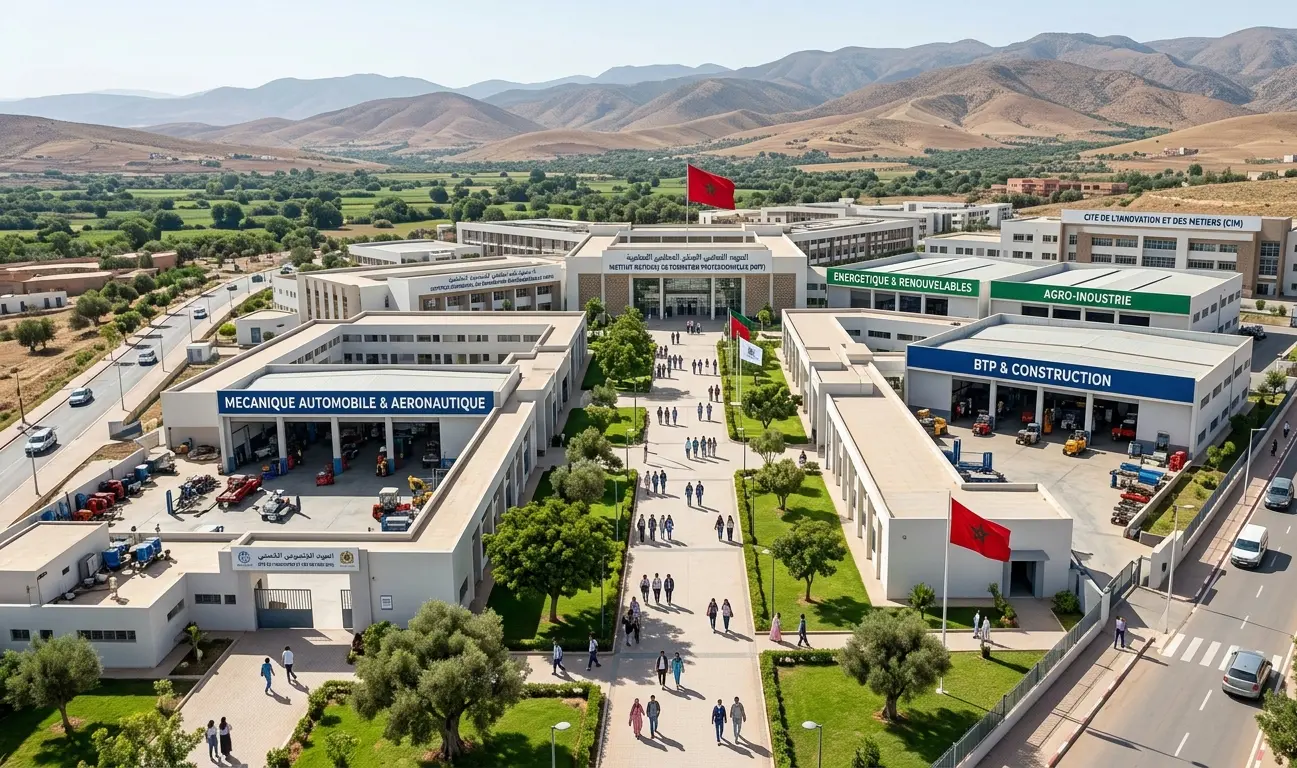
Morocco's Royal mandate created 12 next-generation vocational campuses — CMCs — across every region of the Kingdom.
The government builds them. The government fills them. Private operators are now invited to manage, co-develop, and scale them.
The concession window is open. The demand is sovereign-guaranteed. The market is already inside.
The students are already enrolled. The buildings are already built. The concession is what remains.
The Royal Mandate That Created a New Asset Class
In April 2019, Morocco's King presented a national vocational training roadmap before a full ministerial council. The centrepiece was Project 2: the Cités des Métiers et des Compétences — twelve next-generation campus complexes, one per region, combining technical training, digital infrastructure, residential facilities, and industry-linked placement pipelines under a single roof. This was not a pilot programme. It was a sovereign industrial policy decision, backed by full state financing, and carried through with the kind of velocity that Royal directives generate in the Moroccan administration.
By 2025–2026, ten CMCs are fully operational. The final two are opening. Each campus covers 10 to 20 hectares. Each offers 2,000 to 3,000 training places across ten or more sectoral poles — from renewable energy and industrial mechanics to digital infrastructure, agribusiness, and hospitality management. Boarding, cafeterias, sports infrastructure, coworking spaces, Fab Labs, Digital Factories, and incubators are standard across the network. The state built it. The state filled it. The structure is now ready for private operators.
"The CMC is not a vocational school. It is a workforce factory with sovereign demand guarantees, real estate infrastructure, and a captive corporate client base that has no alternative pipeline."
The PPP Structure — What OFPPT Has Actually Opened
The OFPPT board has publicly confirmed that CMCs will be structured as Sociétés Anonymes — joint-stock companies — specifically to enable private equity entry, management concessions, and co-development partnerships. This is not a future aspiration. It is a governance decision already embedded in the CMC legal architecture. The PPP mechanism explicitly contemplated by OFPPT includes three modes: management concession of existing CMC operations, co-investment in new campus expansion (additional halls, residential blocks, specialised labs), and sector-specific training partnerships with international operators who bring curriculum, certification, and placement pipelines.
The structure is already defined. What matters is how you position within it.
The full PPP term sheet, SA governance model, and OFPPT contact protocol are restricted to qualified applicants.
Apply for Qualification for This Concession Not all applicants are reviewed. Access is not automatic.How You Get Paid — Four Revenue Layers
The CMC revenue model is structurally more diversified than a standard education PPP. Layer one is training fee income: trainees pay MAD 50 in registration fees, but the real revenue is the per-trainee government subsidy and the corporate training contracts with industrial anchors in each region — OCP, Renault, Safran, Stellantis, and dozens of regional SME clusters who have formal partnerships with CMC campuses. Layer two is residential income: the on-campus boarding infrastructure accommodates 16% of the trainee population on average, generating year-round accommodation and catering revenue entirely outside the public budget. Layer three is services income from the commercial infrastructure embedded in each campus — Fab Labs rented to startups, conference centres booked by corporates, Digital Factories contracted by technology companies for short-cycle upskilling programmes. Layer four, available to investors who execute the right structure, is real estate yield: the BEA (Bail Emphytéotique Administratif) over government land combined with campus expansion creates a long-duration asset with compounding income.
The Government's Position in This Investment
OFPPT brings to this concession: the land, the existing buildings, the national brand, the trainee pipeline, the regional employer networks, and the sovereign budget backstop for the training subsidy. The private operator brings: management excellence, international curriculum, corporate placement agreements, and capital for campus expansion. The asymmetry is deliberate. Morocco does not need investors to build the infrastructure — it is already built. It needs operators who can maximise the return on that infrastructure, accelerate placement rates, attract international certifications, and create the kind of outcomes that justify the next wave of expansion.
What You Must Have Before Engaging
The OFPPT evaluation framework for CMC private partners is more demanding than a standard concession tender because the Ministry is not simply outsourcing operations — it is selecting a long-term co-owner of a national brand. Education management or vocational training operational track record is non-negotiable. International certification capability — City & Guilds, German Dual System equivalents, ISO 29990, ILO CINTERFOR methodology — materially differentiates proposals. So does the ability to demonstrate an active employer placement network in Morocco or a comparable MENA market. Corporate training revenue from industrial anchors is not optional upside; it is a core evaluation criterion. Investors who arrive with capital alone and no operational credibility will not pass the first filter.
Three Ways to Enter the CMC Concession
The OFPPT PPP framework accommodates three distinct investor entry profiles. Each leads to a long-duration asset. Each requires a different operational profile and capital commitment.
SA Shareholder.
Full Platform Control.
BEA Land Lease.
New Infrastructure.
Curriculum Partner.
Corporate Pipeline.
The Numbers Behind the CMC Concession
Are Significant.
The full financial model — training fee revenue, corporate contract pipeline, residential income, BEA land yield, World Cup 2030 acceleration premium, and 15-year DCF — is accessible only to qualified applicants under a formal engagement. What can be said openly: the CMC network is already generating revenue. The question is not whether the economics work. The question is which operator captures them.
OFPPT Moves With or Without You
The OFPPT board has already made the strategic decision. The CMC SA structure exists. The PPP filialisation process is active. The Ministry of Employment is under political pressure to accelerate private operator entry before the World Cup 2030 workforce shortfall becomes a national headline. Investors who are not in conversation now are not late — they are absent from a process that is already determining its first-wave partners.
Pre-market engagement with OFPPT's regional directorates, the Ministry of Employment, and the regional Chambers of Commerce is not a courtesy step. It is the decisive variable. The operators who will hold CMC concessions in 2027 are having those conversations today.
Access Is Not Automatic.
Here Is What It Unlocks.
Supremium International provides end-to-end mandate execution for the CMC PPP concession — from the first OFPPT regional directorate contact to signed SA shareholder agreement or BEA concession and financial close. For qualified applicants, the following materials and introductions are made available under a formal engagement agreement.
We do not qualify every applicant. We evaluate whether your operator profile matches what OFPPT's evaluation framework will accept. If you have the right background — vocational training operations, corporate placement networks, international certification — we can open the right doors in five working days.
Most who reach this point will not proceed.
SA equity entry pricing · campus-by-campus revenue benchmarks · BEA land lease terms · OFPPT evaluation matrix weighting · corporate anchor activation playbook · international certification fast-track pathway · full fee structure · pre-market engagement calendar