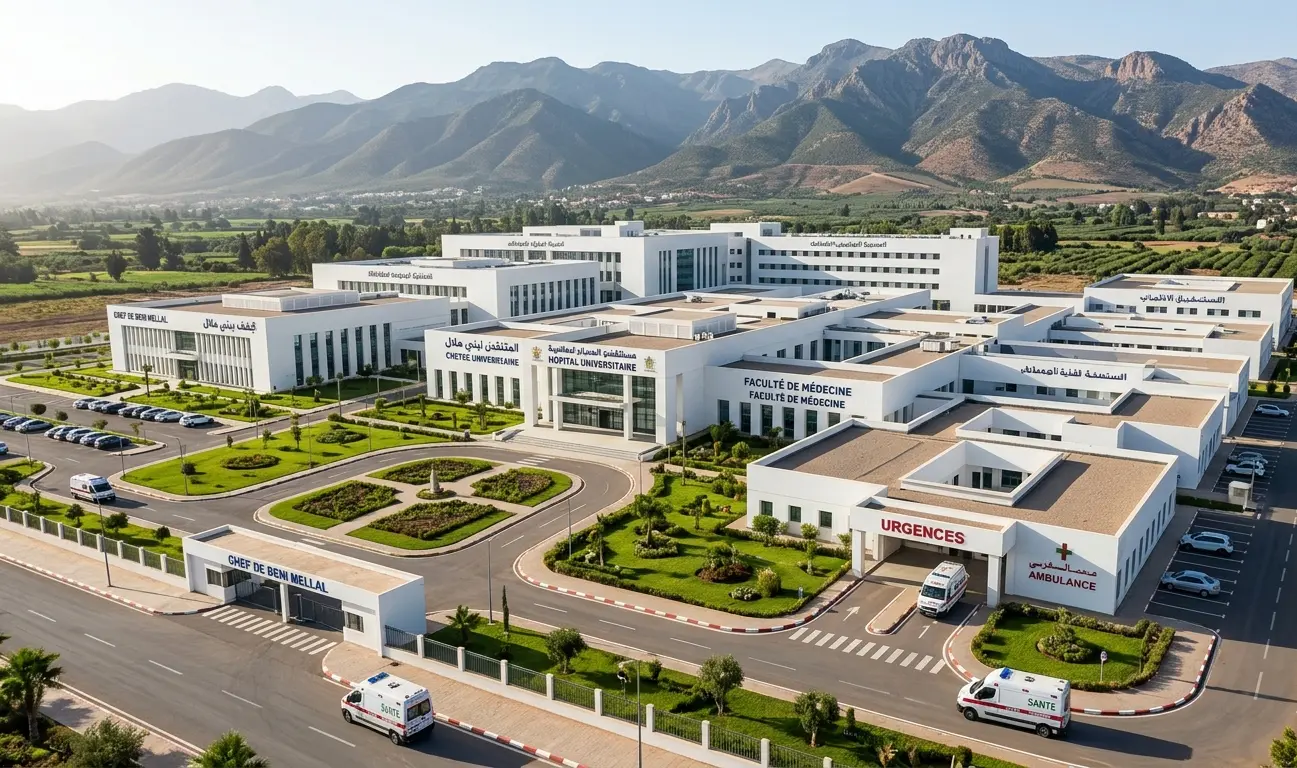
CHU Mohammed V — Béni Mellal, Morocco
DBFM Concession · Ministry of Health PPP Roadmap 2025 Béni Mellal, Morocco · Active Pipeline 2026
P07 · Healthcare · DBFM Concession

Medical Imaging Centre
The State Pays. Every Month. For 15 Years.

Public hospitals in Morocco's secondary cities have waited three months for an MRI scan.
The government has run out of excuses — and budget. The door is now open to private capital.
What the Ministry of Health offers in return is not a promise. It is a guarantee.

Under review only. Access is not automatic.
Verified active pipeline · Ministry of Health PPP Roadmap 2025 · PLF 2026 allocation confirmed
Deal Intelligence — Restricted
Asset Medical Imaging Centre — DBFM
Current Status Active — Ministry PPP Roadmap
Confirmed Fact Availability payment guaranteed by national health budget · BEH 15yr
Last Known Event Waiting time >3 months in target cities — MoH forced acceleration
Financial Upside IRR 15–20% · MAD 18–75M total receipts over 15 years
MAD 140B
Morocco's PLF 2026 health & education allocation — the largest in its history. Medical imaging DBFM concessions are the Ministry's declared top PPP priority. Three secondary cities. Three hospitals. Zero operational imaging equipment.

The queue of patients is not a detail. It is the mandate.

Investment Range
$3–10M
Full DBFM CAPEX including equipment, fit-out & commissioning
Concession Term
15 Yrs
Secured under Bail Emphytéotique Hospitalier (BEH)
Guaranteed Revenue
MAD 2M
Annual availability payment — regardless of patient volumes
Target Cities
3
Béni Mellal · Errachidia · Laâyoune — active pipeline
Exam Fee Upside
8,000
Exams/year potential — MAD 200–600 per examination on top

The Infrastructure Deficit That Cannot Wait

Drive into Béni Mellal on a Tuesday morning and the Hôpital Mohammed V will tell you everything. The waiting room for radiology is full before nine o'clock. Patients who need an MRI are sent to Casablanca, four hours away, with a referral letter and no appointment. The Ministry of Health knows this. The difference now is that they have a legal framework to fix it — and they need private capital to execute it. The DBFM concession is that framework, codified in Morocco's health sector PPP roadmap and fully funded in the PLF 2026.

The structure is already defined. What matters is how you position within it.

"You are not building a private clinic. You are installing sovereign infrastructure — and the sovereign has agreed to pay for its availability, whether or not a single patient walks through the door."

The DBFM Structure — What You Are Actually Buying

The private partner in a DBFM concession is not a healthcare operator in the traditional sense. You are, in legal and financial terms, a landlord and equipment maintainer contracted to a sovereign entity. You build the imaging centre, equip it with MRI, CT scanner, and full radiology capacity, and maintain it for 15 years under a manufacturer-backed SLA. In return, the Ministry of Health pays you a fixed monthly availability payment — guaranteed for the duration of the BEH, regardless of patient volumes. The examination fees collected on top of that are not the primary revenue. They are the upside layer on a structure that was already underwritten before a single scan was performed.

The full financial model, BEH template, and availability payment structure are restricted to qualified applicants.

Apply for Qualification for This Concession Under review only. Access is not automatic.

How You Get Paid — The Two-Layer Revenue Model

Layer one is the availability payment. The Ministry of Health pays between MAD 600,000 and MAD 2 million per year, fixed at contract signature, regardless of how many patients use the centre. It is a contractual sovereign obligation backed by the Ministry of Finance — think of it as a lease payment where the tenant is a government ministry and the lease cannot be broken for fifteen years.

Layer two is examination fee revenue. Patients come through the public health system with no alternative referral path. You do not market to them. You receive them. At MAD 200 to MAD 600 per exam, the upside compounds on a structure that was already underwritten before the first scan. The state delivers the demand to your door.

The Government's Guarantee Package

The hospital building shell is provided free. The availability payment is backed by the Ministry of Finance. Patient referrals come through the public health system — creating a demand floor no commercial operator could build on its own. IFC and AfDB co-financing is available and Supremium manages that engagement for qualified partners. Most importantly: the government manufactures the patient flow. You do not carry demand risk.

What You Must Prepare Before Engaging

This mandate has non-negotiable sector requirements that eliminate the majority of applicants before a single meeting takes place. Medical equipment supply or established hospital management experience is mandatory. You must demonstrate a credible path to ISO 15189 accreditation or equivalent. The Ministry of Health's evaluation committee does not accept commitment letters as substitutes for track record — they have seen too many fail to materialise. If you have an existing relationship with GE Healthcare, Siemens, or Philips, that relationship is worth more than any financial model you could produce.

What Most Investors Miss

Three Things That Eliminated the Last Applicants

The Ministry of Health has evaluated this concession type before. The rejection pattern is consistent. These are not edge cases — they are the reasons qualified-looking investors fail to close.

⚠ Documented Failure Case — 2023

A well-capitalised medical group from France submitted a DBFM proposal for a provincial hospital imaging centre in 2023. Their financial model was sound. Their equipment supplier was confirmed. Their legal team had drafted the BEH terms. The proposal was rejected at Phase 2 evaluation. The reason: the operator had structured the availability payment as a negotiable variable rather than a fixed sovereign commitment. The Ministry's evaluation committee interpreted this as a misunderstanding of the DBFM framework — and treated it as evidence of insufficient operational experience in the Moroccan health PPP context. No second submission was accepted.

The thing they got wrong: assuming that the availability payment mechanism worked like a performance-based contract. It does not. It functions like a lease obligation. The moment an investor attempts to negotiate conditionality into the availability payment — tying it to occupancy rates, exam volumes, or equipment uptime — they have signalled that they do not understand what they are buying. The Ministry closes the door.

The BEH Is Not a Standard Lease
The Bail Emphytéotique Hospitalier operates under a specific legal regime that has material implications for how you structure financing and exit. Most investors assume standard lease mechanics. They are wrong — and the error surfaces at the financial close stage.
🔒 Full BEH structure: restricted access
The Availability Payment Has a Hidden Condition
There is one operational condition embedded in the payment mechanism that virtually every investor reads past in the contract. It is not obvious. When triggered, it can suspend payment for 30 to 90 days without legal recourse. The condition is named but not explained in the standard dossier.
🔒 Payment mechanics: restricted
The Evaluation Timeline Rewards One Type of Applicant
The Ministry's evaluation committee scores applications on a weighted matrix. One of the four criteria has a weight that far exceeds what the published dossier implies. Investors who optimise for the wrong criterion — and most do — score below applicants who understood the actual priority.
🔒 Evaluation matrix: restricted
Entry Paths

Three Ways to Execute This Mandate

The DBFM framework accommodates three distinct investor profiles. Each leads to the same availability payment. Each carries a different risk profile, capital requirement, and operational burden.

Path A
Full Equipment Owner.
Full Operator.
Full Upside.
You supply, install, and maintain the full imaging suite. You operate the centre under your brand. You collect both the availability payment and all examination fees. Maximum control, maximum revenue, maximum regulatory burden. The path that rewards operational healthcare experience — and penalises those without it.
🔒 Structure & capital requirements: restricted
Path B
Equipment Financier.
Management Partner.
Split Revenue.
You finance the CAPEX and hold the BEH. A Moroccan medical management partner operates the centre under a revenue-sharing arrangement. You receive the availability payment; your partner takes a share of examination fees. Lower operational exposure. Requires the right local partner — and knowing how to find and evaluate them.
🔒 Revenue split mechanics: restricted
Path C
Infrastructure Lender.
DFI Co-Finance.
Pure Yield.
You provide senior project finance structured against the availability payment cash flow, co-financed alongside IFC or AfDB. No operating exposure. Yield secured against a sovereign payment obligation. The path for institutional debt investors who want Moroccan sovereign-grade exposure without operational risk. The access conditions are specific and non-obvious.
🔒 DFI co-finance structure: restricted
Financial Structure — Restricted

The Numbers Behind This Concession
Are Significant.

The full financial model — CAPEX breakdown, availability payment calculation, examination fee schedule, IFC co-financing terms, and 15-year DCF — is accessible only under the right structure. What can be said openly: this is not a transaction where the return depends on whether the market develops. The return is structured before the first patient enters the building.

Unlevered IRR
15–20%
EBITDA Margin
40–55%
15yr Total Revenue
MAD 18–75M
Exit Multiple
8–10× EBITDA
Apply for Private Access Under review only. Access is not automatic.
Why This Window Is Closing

The Ministry Moves With or Without You

The PLF 2026 allocation is fixed. The DBFM concession dossiers for Béni Mellal, Errachidia, and Laâyoune are in active preparation. The Ministry of Health does not wait for investors to complete their due diligence cycles. The dossiers will be published. The evaluation window will open and close. The concession will be awarded — to whichever qualified operator was positioned before the committee formed its view.

The investors who succeed in Moroccan health PPPs are not the ones with the best financial models. They are the ones who had the right conversations before the tender was published. Pre-market engagement is not a courtesy. It is the decisive variable.

1
The Dossier Publication Window Is Open Now The Ministry of Health is finalising DBFM dossiers under the 2025 PPP roadmap. Once published, the pre-qualification period is 30 days. Operators who engage after publication are building their proposal from a standing start against competitors who have had months of access.
2
IFC Co-Financing Slots Are Allocated Before Tender IFC Morocco operates on a first-engagement basis for health PPP co-financing. There are a finite number of projects they will support in this concession wave. The slot allocation happens in relationship, not in procurement. It is already being discussed.
3
The Moroccan Partner Landscape Is Narrowing There are a small number of qualified Moroccan medical management operators capable of executing the operational component of a health DBFM. The best ones are already in early-stage conversations with international investors. Partner availability is time-limited.
4
Secondary Cities Will Not Be the Only Wave This is the first DBFM wave. The Ministry's roadmap includes tertiary hospitals and regional health centres. The operators who demonstrate competence in this wave will have a structural advantage — including preferential treatment — in the next one. First wave entry is not optional for those who want long-term position.
What Qualified Investors Receive

Access Is Not Automatic.
Here Is What It Unlocks.

Supremium International provides end-to-end mandate execution — from the first Ministry of Health contact to signed concession and financial close. For qualified applicants in the P07 Medical Imaging DBFM mandate, the following materials and services are made available under a formal engagement agreement.

Qualification is not a formality. We evaluate whether your profile matches what the Ministry's evaluation committee will accept. We do not work with applicants who require the process to generate their credentials. If you have the right background, we can move in five working days.

Most who reach this point will not proceed.

Apply for Qualification for Private Access Not all applicants are reviewed. Access is not automatic. Request a Confidential Call
Complete DBFM Financial Model
IRR, DSCR, payback, 15-year DCF — French, Arabic, English
BEH Template & Ministry Contacts
Bail Emphytéotique Hospitalier · Real names · Approach strategy
Moroccan Medical Partner Shortlist
Classified, qualified, network-connected operators — introduced within 5 days
IFC Co-Financing Facilitation
Active engagement · 50–60% CAPEX financed · Sovereign-endorsed

Availability payment schedule · Evaluation matrix weighting · Hospital site coordinates · Ministry contact protocol · Pre-market engagement timeline · Provisional guarantee arrangement · Equipment supplier financing terms · Full fee structure breakdown

🔒 Restricted Access Layer Request Access to Unlock
Private Access

The State Has Already Signed the
Guarantee. The Question Is Who Collects It.

Most who read this page will never move forward. Under review only. Access is not automatic.